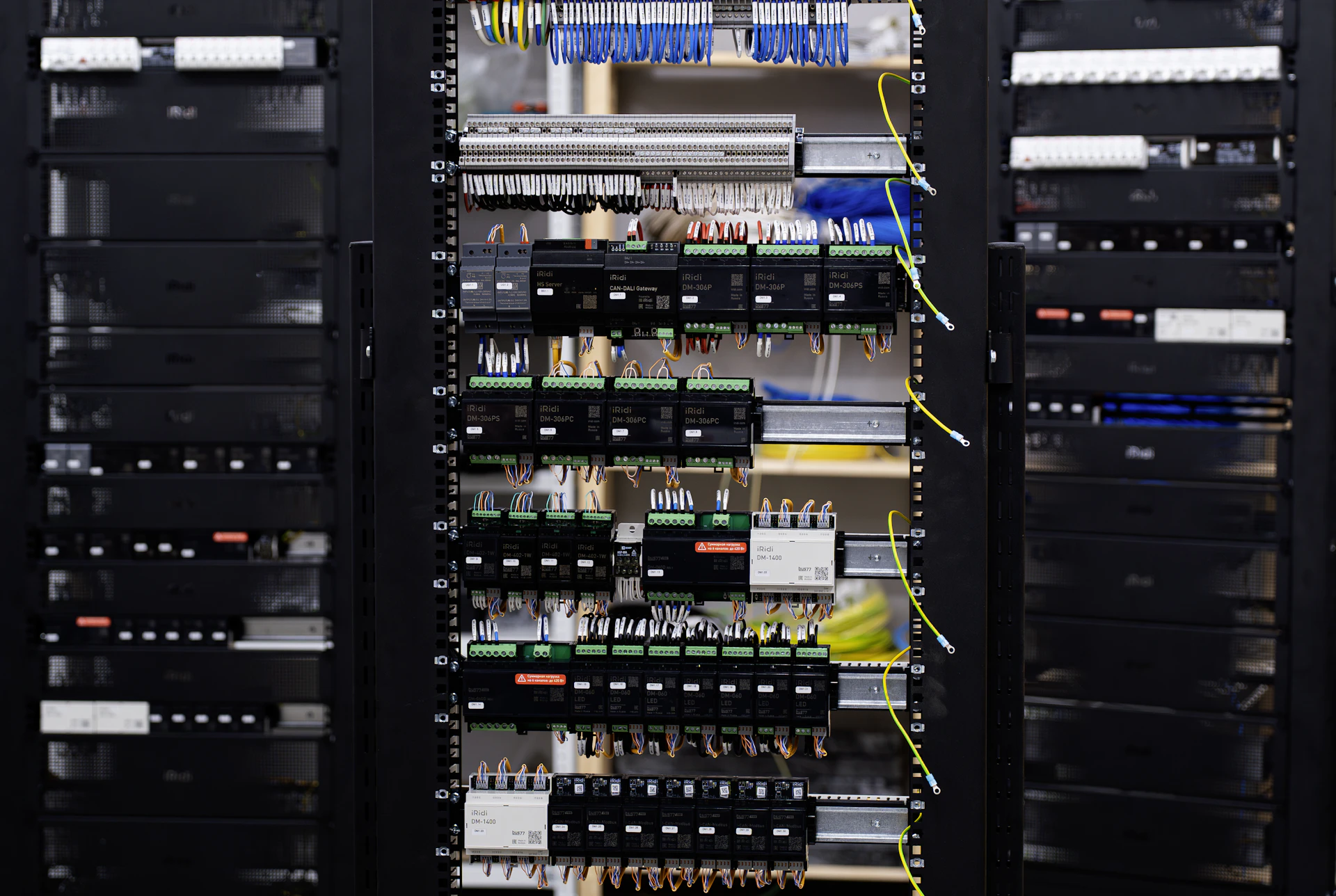
Industrial control systems were designed for reliability in isolated environments. Today they are connected to business networks, remote sites, vendors and cloud services. Those connections bring efficiency and visibility, and they expose systems that control physical processes to threats designed for IT environments. Attacks on industrial organizations — including ransomware that disrupts operations even without touching controllers — have made OT security a board-level concern.
Why OT security is different
- Consequences are physical: loss of control can affect safety, the environment and service to customers.
- Availability is paramount: security measures must not interrupt the process.
- Legacy systems: many devices cannot be patched quickly, run old operating systems or lack authentication.
- Specialized protocols: industrial protocols such as Modbus and DNP3 were often designed without security features.
- Shared responsibility: vendors, integrators, operations and IT all touch the systems.
Frameworks and standards
| Framework | Scope | How it is used |
|---|---|---|
| NIST Cybersecurity Framework 2.0 | Organization-wide risk management | Govern, Identify, Protect, Detect, Respond, Recover functions to structure a program |
| NIST SP 800-82 Rev. 3 | Guidance for OT security | Architecture, risk management and control overlays for OT |
| ISA/IEC 62443 | Industrial automation and control systems | Zones and conduits, security levels, requirements for asset owners, integrators and product suppliers |
| CISA Cross-Sector Cybersecurity Performance Goals | Baseline practices | Prioritized, measurable practices for critical infrastructure |
| Sector requirements | Applicable entities | For example, NERC CIP for the bulk electric system and TSA security directives for designated pipelines |
Prioritized controls
The following controls address the most common weaknesses found in industrial environments. Their order reflects typical risk reduction for effort, though each organization should prioritize based on its own assessment.
- Asset inventory: know every device on OT networks — type, firmware, location, owner, communications. Use passive discovery on sensitive networks.
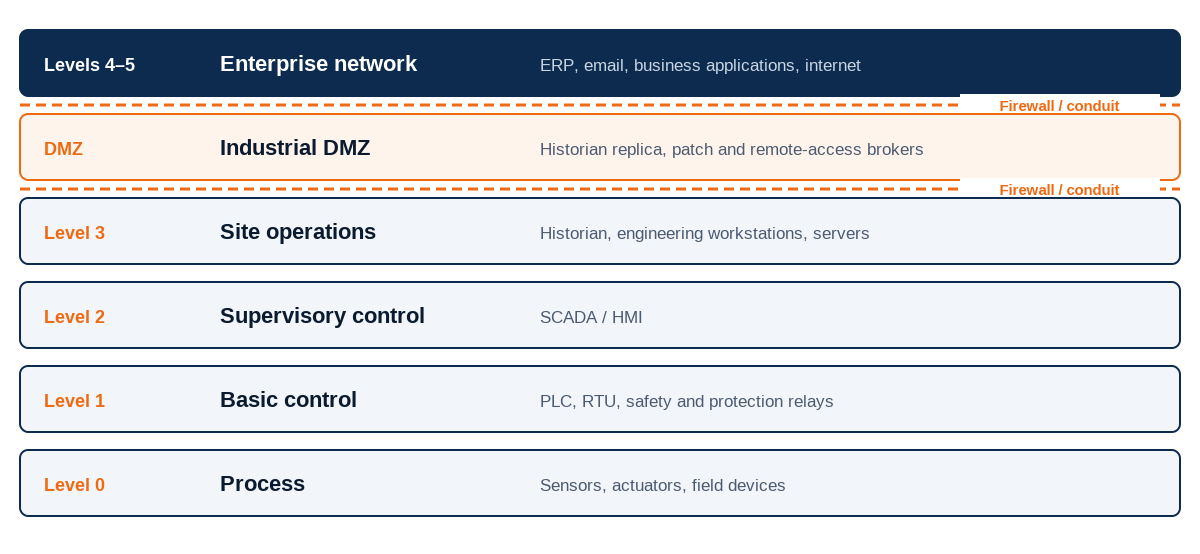
- Segmentation: separate IT and OT with firewalls and an industrial DMZ; divide OT into zones; remove dual-homed hosts.
- Secure remote access: brokered access through the DMZ, multi-factor authentication, individual accounts, session logging and time-limited vendor access.
- Account management: remove shared and default accounts where feasible; least privilege; protect administrator credentials.
- Backups and recovery: offline or immutable backups of configurations, programs and servers; tested restoration; documented recovery procedures.
- Vulnerability and patch management: risk-based patching coordinated with vendors; compensating controls when patching is not possible.
- Monitoring: log collection and network monitoring tuned for industrial protocols; defined alert response.
- Incident response: OT-specific plans, roles, communication with operations and regulators, and regular exercises.
- Supply chain: security requirements in procurement; verification of vendor software and remote support practices.
- Training: awareness for operators and engineers, focused on realistic scenarios.
Ransomware and operations
Many operational disruptions come from ransomware on business networks: operators shut down processes because they cannot bill, schedule or trust the integrity of shared systems. Reducing that risk requires segmentation, independent OT recovery capabilities and clear decision criteria for when to isolate OT from IT.
Assessment approach
A practical assessment combines interviews, document review, architecture analysis and passive traffic analysis. Active scanning or penetration testing of production control systems carries operational risk and should only be done with careful scoping, coordination with operations and vendors, and preferably on test systems or during outages.
Measuring progress
- Percentage of OT assets inventoried with known firmware
- Number of IT–OT connections not passing through the DMZ
- Remote access sessions using MFA and logging
- Backups tested in the last quarter
- Time to detect and respond to exercise scenarios
Sources and further reading
- NIST, Cybersecurity Framework 2.0
- NIST, SP 800-82 Rev. 3: Guide to Operational Technology (OT) Security
- ISA, ISA/IEC 62443 Series of Standards
- CISA, Cross-Sector Cybersecurity Performance Goals
- CISA, Industrial Control Systems
- NERC, Reliability Standards (CIP)