

The challenge
Connected operations, expanding risk
Industrial organizations have connected control systems, cameras, sensors and remote sites to business networks and the internet to gain visibility and efficiency. The same connections expose systems that were never designed to face modern threats, and ransomware on business networks regularly disrupts operations indirectly.
- No complete inventory of devices on operational networks
- Flat networks between office and control systems
- Shared accounts and unmanaged remote access
- Backups that have not been tested against ransomware scenarios
- No plan for what to do during an incident
Scope
What we deliver
Risk assessment
Review of architecture, assets, access and practices against NIST Cybersecurity Framework 2.0 functions and ISA/IEC 62443 concepts, with prioritized recommendations.
Asset inventory
Identification of devices, firmware and communications, using passive methods on sensitive networks.
Segmentation
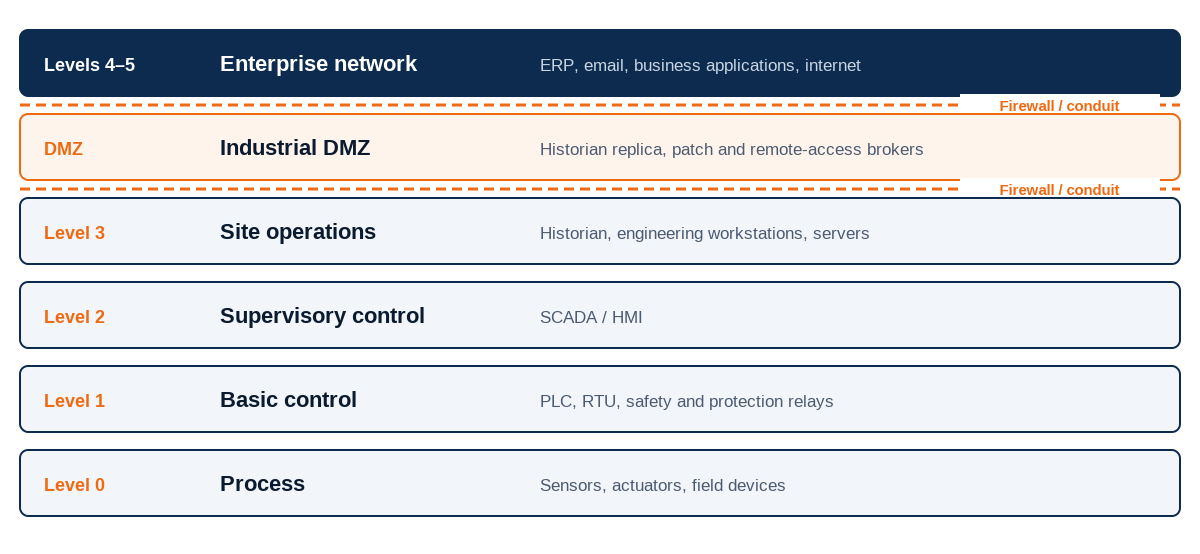
Zones and conduits, industrial DMZ and firewall policies that limit how threats can spread.
Hardening
Secure configurations, account management, patch strategy and removal of unnecessary services.
Remote access
Brokered, MFA-protected and logged access for employees and vendors.
Incident preparedness
Backups, recovery procedures, response plans and tabletop exercises.
OT data
Moving operational data to the business, securely
Production, maintenance and engineering teams need data from control systems: historian values, alarms, meter readings and equipment status. Pulling that data directly from control networks is one of the most common ways operational technology ends up exposed.
We design and implement the path OT data takes to business systems and the cloud: collection on the control side, replication through an industrial DMZ, firewall rules limited to the flows that are actually required and, where the risk justifies it, one-way (unidirectional) transfer. Authenticated connections, time synchronization and logging protect data integrity, so the values that reach reports and dashboards can be traced to their source.
Typical scope
Secure OT-to-IT data transfer
- Inventory of who needs which OT data, and how often
- Industrial DMZ with historian or data-broker replication
- Firewall rules and remote access limited to defined flows
- Unidirectional gateways where risk or regulation justifies them
- Logging, time synchronization and alerts on unexpected traffic
- Coordination with your historian, SCADA and cloud vendors
Approach
Risk-based and operations-aware
Security measures in operational environments are introduced in a sequence that respects availability and safety. Active scanning, patching and configuration changes on control networks are coordinated with system owners and vendors and scheduled in maintenance windows.
Recommendations reference public frameworks — NIST CSF 2.0, NIST SP 800-82 Rev. 3, ISA/IEC 62443 and CISA guidance — and, where they apply to your organization, sector requirements such as NERC CIP or TSA pipeline security directives. Read cybersecurity for industrial infrastructure.
Process
How an engagement runs
- Scope Sites, systems, regulatory context and constraints.
- Assess Interviews, documentation review, architecture and passive discovery.
- Prioritize Findings ranked by risk and effort into a roadmap.
- Implement Segmentation, hardening, access and backup improvements.
- Prepare Response plans, exercises and periodic reassessment.
Deliverables
What you receive
- Executive summary and risk-ranked findings
- OT and IT asset and communication inventory
- Current and target zone and conduit architecture drawings
- Prioritized roadmap with effort and operational impact
- Configurations for the firewall, switch and remote-access changes implemented
- Incident response and recovery procedures, with exercise records
Frequently asked questions
Do you perform penetration testing on control systems?
Active testing of production control systems carries operational risk. Where testing is needed it is scoped carefully, often on test systems or during outages, with the system owner’s approval.
Can you help with compliance audits?
We help implement and document controls. Formal compliance determinations are made by the applicable regulator or auditor.
Do you provide 24/7 OT monitoring?
Vector does not operate a 24/7 security operations center. We deploy and tune passive OT network monitoring, route its alerts to your team or to the managed security provider that watches your environment around the clock, and document how alerts are escalated.
Do you supply OT data management software?
No. Historians, industrial data platforms and analytics software remain with their vendors under your licenses. Our scope is the secure architecture around them: networks, DMZ, access, data paths and the integration with business systems.