Industrial organizations run two kinds of computing: business IT (email, ERP, file shares) and operational technology (OT) that monitors and controls physical processes — SCADA, historians, HMIs, PLCs and safety systems. The servers and networks that support OT must meet requirements that differ from office IT: availability first, deterministic communications, long equipment lifecycles, harsh environments and strict change control.
IT and OT priorities
| Aspect | Business IT | Operational technology |
|---|---|---|
| Top priority | Confidentiality and data integrity | Availability and safety |
| Change windows | Frequent, often automated | Limited, scheduled with operations |
| Equipment lifecycle | 3–5 years | Often 15–20 years or more |
| Patching | Regular and rapid | Tested, vendor-qualified, scheduled |
| Environment | Offices and data centers | Plants, substations, field enclosures |
Reference architecture
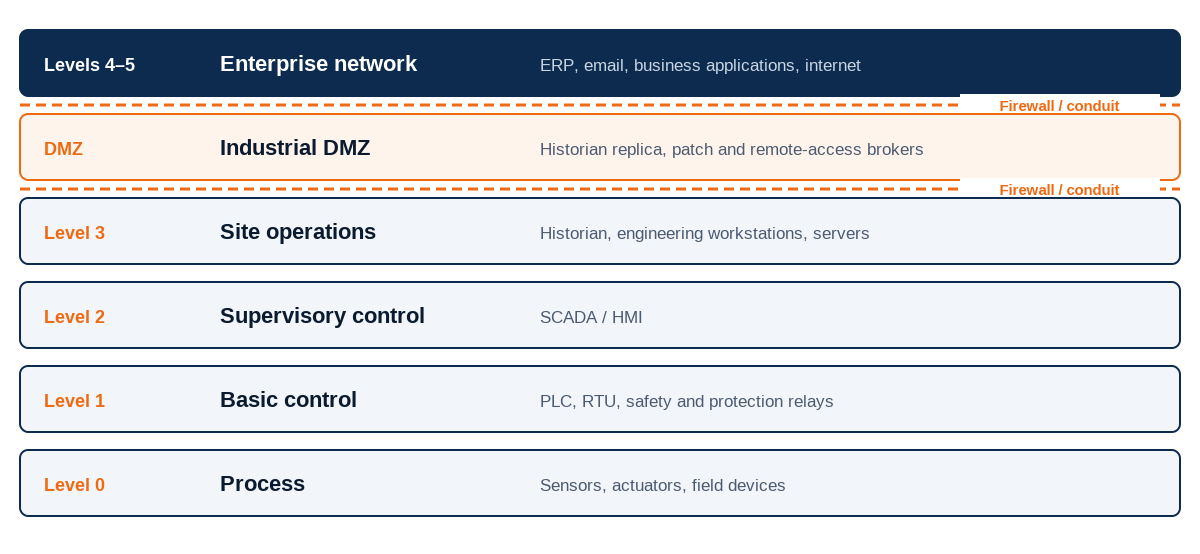
A widely used reference is the Purdue model, which organizes systems in levels from the physical process (Level 0) up to enterprise systems (Levels 4–5). ISA/IEC 62443 builds on this with zones (groups of assets with similar security requirements) and conduits (controlled communication paths between zones). A typical design includes:
- Enterprise zone: business systems and internet access.
- Industrial DMZ: the only place where IT and OT exchange data — for example a historian replica, patch server or remote access gateway.
- Site operations zone: historians, engineering workstations, OT domain services.
- Control zones: SCADA servers and HMIs, separated by area or process.
- Field and safety zones: PLCs, RTUs, safety instrumented systems.
Network design
- Managed industrial switches with VLANs, port security and monitoring, rated for temperature and vibration where needed.
- Redundant topologies such as rings with fast recovery protocols, or dual networks for critical systems.
- Defined traffic flows documented and enforced by firewalls between zones.
- Time synchronization (NTP or PTP) for accurate event logs and sequence-of-events data.
- Remote sites connected by fiber, licensed radio, cellular or satellite, with link budgets and failover.
Server design
- Virtualization consolidates OT servers on clustered hosts, improving resilience — but only with software vendors’ support statements verified.
- Redundancy for critical servers: power supplies, disks, network interfaces, and clustered or standby systems.
- Out-of-band management for remote recovery.
- Backups stored separately, including offline or immutable copies, with periodic restore tests.
- Environmental design: cooling, filtered enclosures and UPS sized for the site.
Documentation
Industrial networks often outlive the people who built them. Minimum documentation includes network diagrams by zone, IP addressing, asset inventories with firmware versions, firewall rule purposes, configuration backups and recovery procedures. Documentation should be updated as part of every change, not afterwards.
Change management
Changes to OT networks and servers should follow a management-of-change process: risk assessment, coordination with operations and control system owners, testing in a staging environment where possible, scheduled windows, rollback plans and post-change verification.
Common pitfalls
- Flat networks where office PCs can reach controllers directly.
- Dual-homed computers bridging IT and OT networks.
- Consumer-grade or unmanaged switches in critical paths.
- Undocumented vendor remote access.
- Backups never tested, or stored on the same network they protect.
Sources and further reading
- NIST, SP 800-82 Rev. 3: Guide to Operational Technology (OT) Security
- ISA, ISA/IEC 62443 Series of Standards
- CISA, Industrial Control Systems