
The challenge
Large assets, limited access, competing priorities
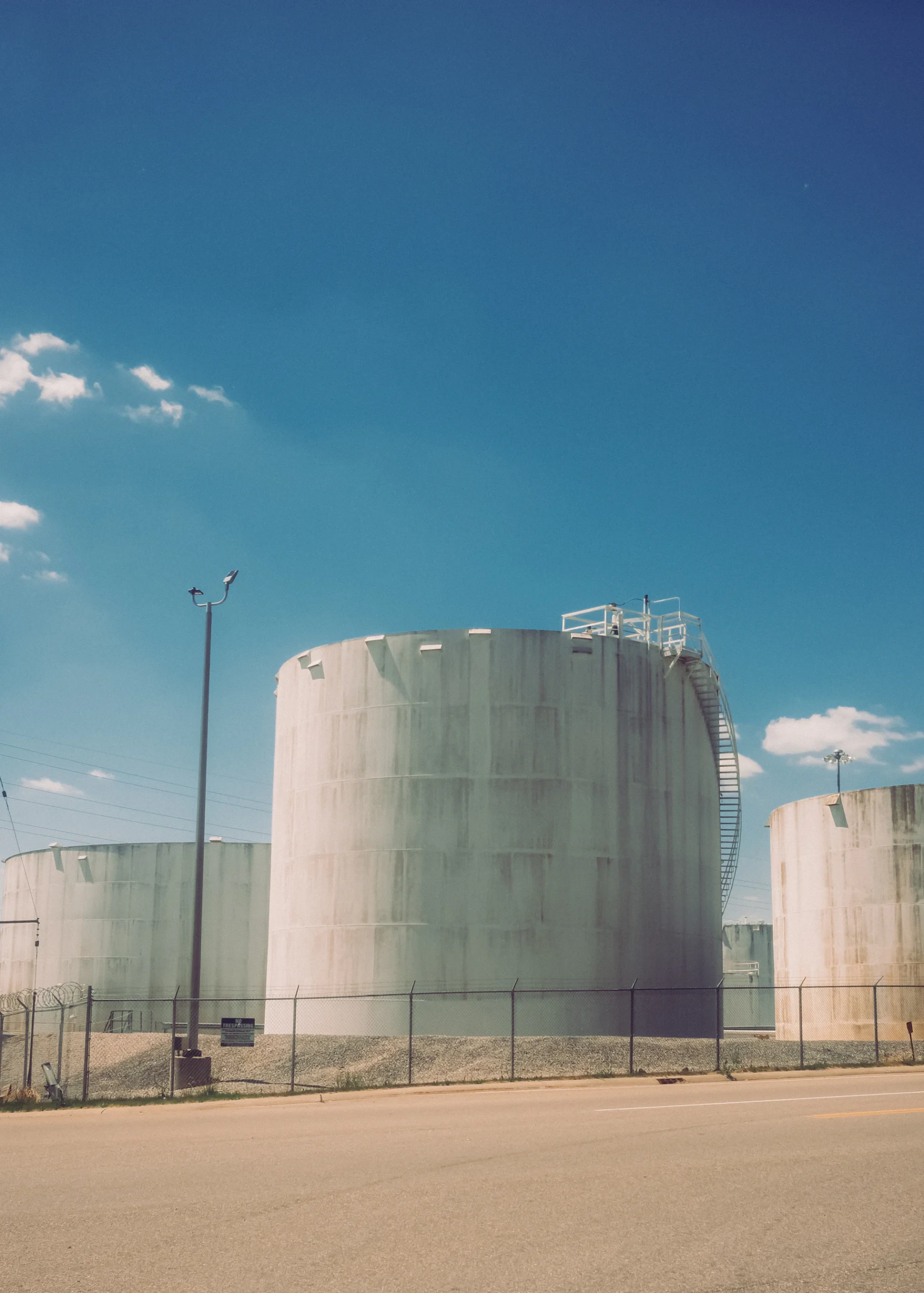
Industrial facilities contain many assets that are rarely seen up close: storage tank roofs, stacks, cooling towers, conveyor galleries, building roofs, pipe bridges and structural steel. Inspecting them traditionally requires scaffolding, lifts, rope access or shutdowns, so it tends to be deferred.
Aerial inspection makes it practical to screen these assets regularly, focus hands-on work where it is needed and keep comparable records over time.
- Tank roofs, shells and floating roof seals
- Stacks, chimneys and flare structures
- Building roofs, gutters and penetrations
- Conveyor galleries, pipe bridges and structural steel
- Cooling towers, fans and elevated equipment
Our approach
Inspect, measure, record
Visual screening
Close imagery of coatings, corrosion, deformation, cracks, missing components and debris.
Thermal survey
Heat loss, insulation damage, refractory issues, moisture in roofs and electrical anomalies.
3D documentation
Photogrammetric models and point clouds for measurement, engineering and planning.
Asset-keyed records
Imagery and findings organized by your asset IDs for comparison on the next survey.
Safety
Working within your plant rules
Plant flights are coordinated with your HSE team: hazardous area classifications, permit-to-work, radio procedures, restricted areas and emergency response. Mission plans keep the aircraft away from process hazards and personnel, and flights are paused when site conditions change.
Interior inspections of tanks, boilers or enclosed spaces require additional planning and specific equipment; their feasibility is evaluated case by case.
Deliverables
What you receive
- Findings register by asset with photos and severity
- Thermal images with temperature data where in scope
- 3D models and measurements
- Asset photo library for future comparison
- Summary report for maintenance planning
How an asset inspection runs
- Asset list Define assets, components and what must be detected.
- Safety plan Site rules, permits, exclusion zones and coordination.
- Capture Visual, thermal and mapping flights.
- Review Asset-by-asset review and finding classification.
- Deliver Report and data in the Geospatial Platform or your CMMS.
Frequently asked questions
Does this replace mandatory inspections?
No. Code-required inspections must be performed by qualified inspectors with the methods specified. Aerial screening helps plan and target that work and documents condition between inspections.
Can you measure corrosion thickness?
Aerial imagery identifies visible corrosion; wall thickness measurement requires contact methods such as ultrasonic testing.
Can findings feed our CMMS?
Yes. Findings can be exported with asset IDs for import into maintenance systems.
Related
Related services and references
Oil & Gas Infrastructure
Well pads, stations, terminals and flares.
Thermal Inspection
Radiometric infrared surveys.
Preventive Maintenance
Maintenance programs for technology and plant systems.