
The challenge
Availability first, in harsh environments
Operational networks carry the traffic that keeps a process running. They must tolerate heat, dust, vibration and electrical noise, stay available during maintenance, and remain isolated from threats on business networks — often at sites hours from the nearest technician.
- Flat networks connecting PLCs, HMIs and office PCs
- Unmanaged switches with no visibility or redundancy
- Remote sites relying on a single fragile link
- Undocumented connections installed by different integrators
Scope
What we deliver
OT network design
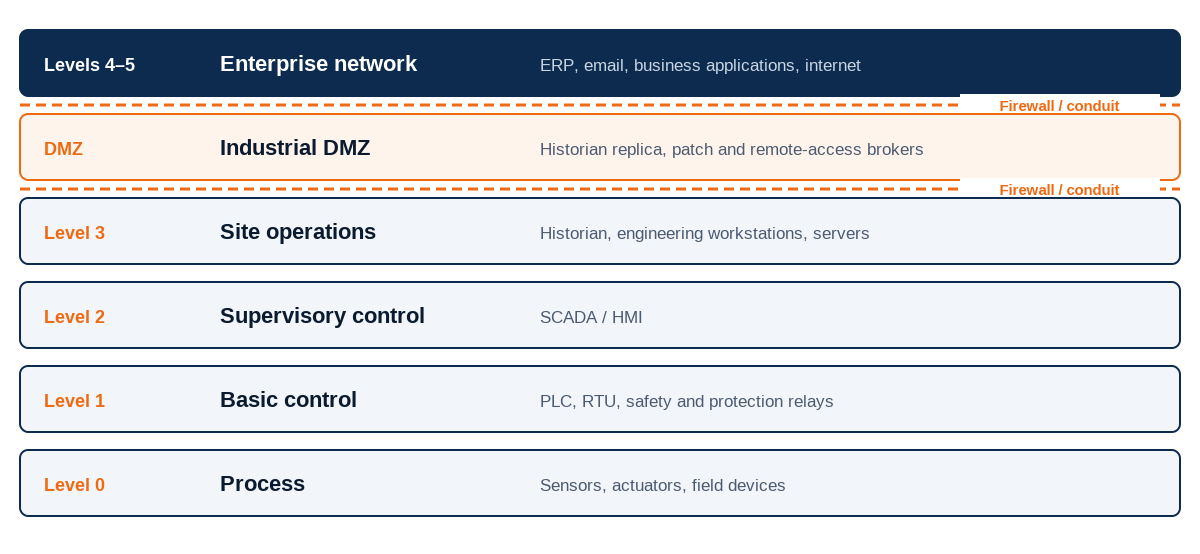
Zones and conduits, ring or redundant topologies and managed industrial switching.
Segmentation
Separation between enterprise, DMZ and control zones with firewalls and defined traffic flows.
Remote connectivity
Fiber, licensed or unlicensed radio, cellular and satellite links, with failover where justified.
Visibility
Network monitoring and passive asset discovery designed not to disturb sensitive devices.
Remote sites
Remote site connectivity for field operations
Well pads, compressor and pump stations, substations, water facilities and construction sites often sit beyond the reach of wired networks. The link for each site is chosen from fiber, licensed or unlicensed radio, cellular and satellite according to bandwidth, latency, availability and cost, and is documented so it can be supported later.
| Site need | Typical approach |
|---|---|
| SCADA polling and alarms | Radio or cellular, with a secondary path at critical sites |
| Video and high-volume data | Fiber or point-to-point radio; satellite where nothing else reaches |
| Temporary or mobile sites | Cellular or satellite kits behind a managed firewall |
| Many dispersed sites | A standard site design, centrally managed and documented |
Deliverables
What you receive
- Zone and conduit drawings
- Asset and connection inventory
- Switch and firewall configurations
- Link budgets for radio and remote links
- Commissioning test records
Design principles follow ISA/IEC 62443 and NIST SP 800-82 guidance. Learn more in industrial server and network integration.
Process
How a project runs
- Survey Site walk-downs, existing devices, links and documentation.
- Design Zones, topology, link selection and bill of materials.
- Stage Equipment configured and tested before it reaches the site.
- Install Cut-over in planned windows, with rollback plans.
- Hand over As-built drawings, configurations and test records.
Frequently asked questions
Can you work on a running process network?
Yes, with planned windows, coordination with control system owners, staged changes and rollback plans. Some changes require a scheduled outage, which is identified in the plan.
Do you program PLCs or SCADA?
Our scope is the network and infrastructure around control systems. Control logic remains with your control system integrator or engineering team, and we coordinate with them.
Do you provide radio and satellite links for remote sites?
Yes, as part of a network project: link selection, link-budget analysis, equipment configuration, installation coordination and commissioning tests. Licensed radio links require an FCC license held by the operator, which is identified during design.